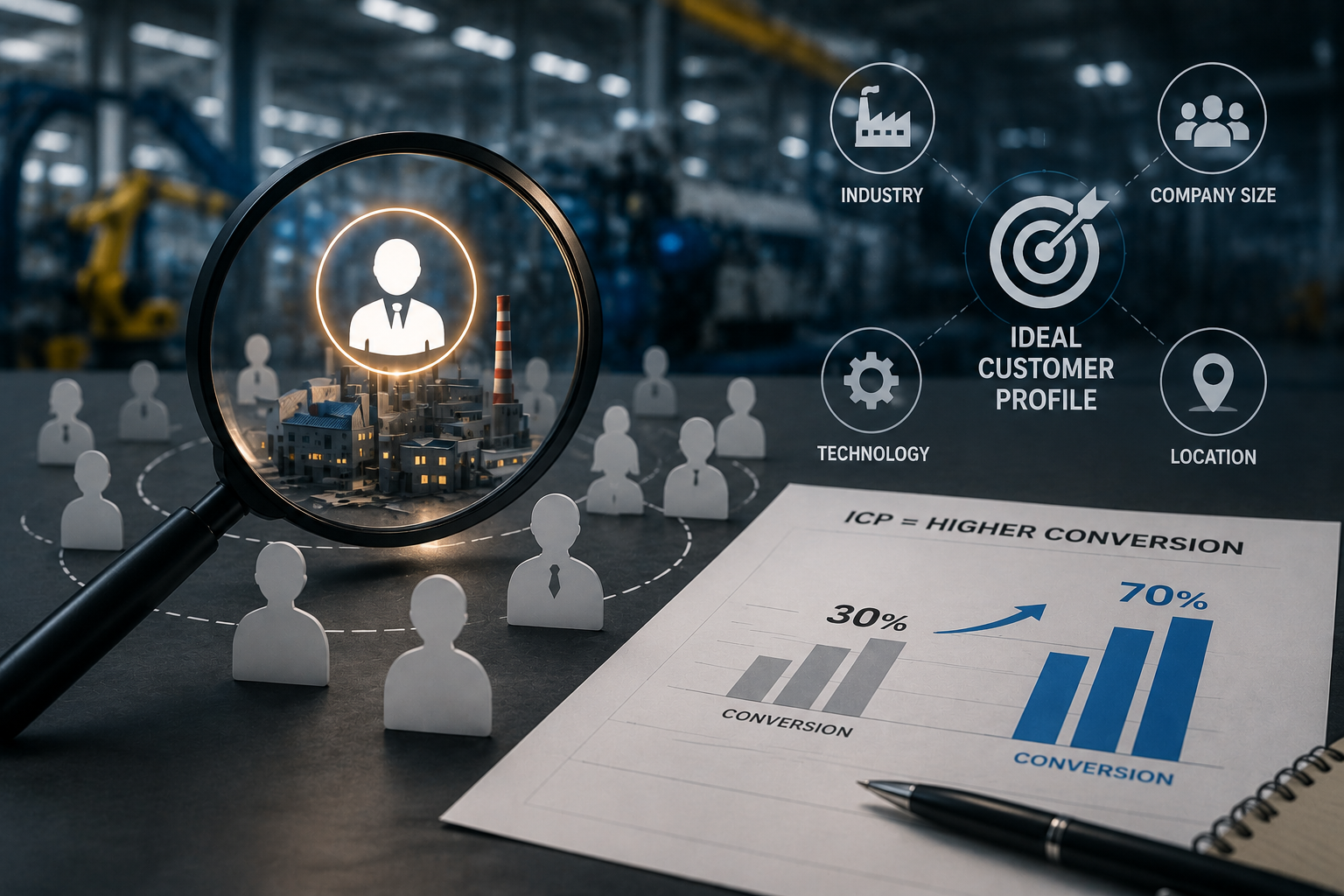
The ICP Problem in Industrial Sales
Ask most industrial companies who their ideal customer is, and the answer comes back too broad: 'manufacturing companies in India,' 'engineering businesses in Maharashtra,' or 'any company that needs our product.' These answers describe a market, not a customer profile. The distinction matters more in industrial B2B than almost anywhere else — because in a sector where buying cycles run 6–18 months and proposals require significant investment, reaching the wrong company is not just inefficient, it is expensive.
What ICP Actually Means in Industrial B2B
An Ideal Customer Profile is a precise description of the specific type of organisation most likely to buy your product, derive significant value from it, and return for repeat business. In industrial B2B, a real ICP has six dimensions: industry and application (not just 'manufacturing' but 'Tier-1 automotive component suppliers producing safety-critical stampings'), company size and revenue, geography, buying maturity (do they have a procurement process for this category?), decision-making structure (who controls the buy?), and technical fit (does the application match the product's actual capability?).
Most industrial companies collapse these six dimensions into one or two — industry and geography — and call it an ICP. The result is an account list that is too large, too unfocused, and full of accounts that will never convert regardless of outreach quality.
The Cost of a Vague ICP
A poorly defined ICP creates compounding problems at every stage of the pipeline. Outreach volume increases because more accounts are targeted. Response rates fall because the messaging cannot be specific enough to resonate. The sales team spends time on qualification conversations that go nowhere. Proposals are written for companies that cannot or will not buy. Follow-up resources are spread across too many accounts to be disciplined on any of them.
The financial impact is direct: sales cost per acquisition rises, conversion rate on proposals falls, and the pipeline contains a high proportion of dead or stalled opportunities that consume reporting and review time without producing revenue.
How to Build a Real Industrial ICP
The most reliable starting point is the existing customer base. Identify the top 10–15% of current customers by revenue, margin, and ease of doing business — the accounts that buy predictably, pay reliably, and require relatively little post-sale service. Then build a detailed profile of those accounts across all six dimensions.
- ·Industry and specific application — not just 'process industry' but 'chlor-alkali plants requiring corrosion-resistant fluid handling systems'.
- ·Revenue range — which turnover band corresponds to a buying budget that matches your pricing?
- ·Geography — which markets have the procurement infrastructure to evaluate and approve your product?
- ·Buying maturity — does the company have a structured vendor approval process for your product category?
- ·Decision-making unit — is the buy controlled by a plant head, a purchase committee, a group procurement function?
- ·Technical qualification — which product specifications, certifications, or application requirements are mandatory for a fit?
Operationalising the ICP: From Definition to Target List
A completed ICP definition is useful but not yet actionable. The next step is translating it into a target account list — the specific organisations that match the profile, in ranked order of fit and potential. This requires market research: identifying companies in the target industries, filtering by size and geography, cross-referencing against known buying patterns, and mapping the decision-making contacts at each account.
For most industrial companies, this research step is where the ICP work stops — because they do not have the research capacity or the outreach capability to make use of a large, well-structured target list. Building that capability, or partnering with someone who has it, is the step that converts a good strategy document into a working pipeline.
The Compounding Effect on Conversion Rates
The most immediate impact of a tighter ICP is visible in proposal conversion rates. When proposals are submitted only to accounts that genuinely fit the profile — correct application, appropriate size, verified buying authority, established need — conversion rates improve substantially. Resources that were previously spread across 50 marginal opportunities can be concentrated on 15 high-fit accounts, with significantly more depth of engagement, more thorough pre-proposal discovery, and more relevant proposals.
The second-order effect is on the sales team's time. Qualification conversations are shorter because the account list already contains pre-qualified companies. Proposal writing is faster because the requirements are more predictable. Follow-up is more disciplined because the number of active opportunities is smaller and each one has a higher probability of closing.
Frequently asked questions
Our product serves multiple industries — does that mean our ICP has to be broad?
No. Multiple industries means multiple ICPs — one for each application segment. What it should not mean is a single vague profile that tries to describe all of them simultaneously. A company that serves both automotive Tier-1 suppliers and chemical plant operators has two distinct buyer profiles, two distinct decision-making structures, and two distinct sets of value propositions. Treating them as one produces outreach and proposals that resonate with neither.
How specific should our ICP actually be?
Specific enough that someone could use it to build a target account list without asking you to clarify. If the profile could describe 10,000 companies, it is not specific enough. If it describes fewer than 50 reachable companies, it may be too narrow. For most industrial companies, a well-defined ICP for a single segment should describe somewhere between 200 and 2,000 realistic target accounts — enough to sustain a multi-year pipeline development effort.
Can we have more than one ICP?
Yes, but each one requires separate outreach, separate messaging, separate decision-maker mapping, and separate follow-up resources. Running two ICP-led campaigns simultaneously is entirely viable if you have the execution capacity. Running five simultaneously without the capacity to execute properly on any of them produces the same outcome as having no ICP at all.
How do we know if our current ICP is wrong?
Look at your proposal conversion rate, your average sales cycle length, and the proportion of proposals that go to 'no decision'. If conversion is below 20%, cycle length is longer than expected for your product category, or 'no decision' is a frequent outcome, the most likely cause is that you are submitting proposals to accounts that should have been disqualified earlier. A wrong ICP keeps those accounts in the pipeline instead of removing them at the qualification stage.